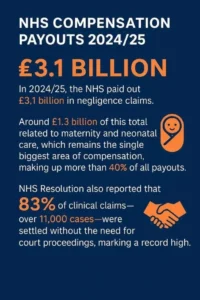
Our NHS compensation payouts guide uses the latest compensation and claims figures from the NHS to examine what has been paid out across multiple areas of medical practice. While the standards within the NHS and NHS providers are generally very good, mistakes in surgery, diagnosis and treatment can occur and have lasting consequences for patients and their families.
As well as examining the latest figures, this comprehensive guide covers the medical negligence claims process from top to tail, looking at the eligibility requirements to start a claim, how compensation values are actually determined and what our dedicated No Win No Fee solicitors can do to give your potential claim the best possible chance of success. Get in touch with our advisors at a time that suits you to find out if you could make a claim today.
4.8 (466 reviews)
We're No Win No Fee Solicitors Trusted by thousands to win compensation.
The core of our NHS compensation payouts guide is the latest figures from NHS Resolution, the arm’s length body of the Department of Health and Social Care responsible for handling claims and complaints arising from clinical negligence with the NHS. The data you can see below was taken from NHS Resolution’s Annual Statistics.
Additional guidance can be sought from our advisors via the details given below.
NHS Payout Amounts By Speciality
This table sets out the total number of claims settled and the total compensation paid by NHS Resolution last year. The data is sorted by area of medical practice.
Speciality
Number of Claims Settled
Total Compensation Payout In £
Obstetrics CP/BD
239
985,894,456
Neonatology CP/BD
17
27,012,531
Paediatrics
216
173,389,615
Emergency Medicine
1,602
168,942,556
Orthopaedic Surgery
1,326
109,916,098
General surgery
688
63,256,078
Neurosurgery
178
53,981,679
General medicine
473
42,002,492
Gynaecology
687
34,119,324
Radiology
523
43,847,548
Neurology
150
26,821,543
Psychiatry/ Mental Health
390
31,256,233
Ophthalmology
315
21,612,482
Cardiology
230
18,870,240
Ambulance
199
18,196,051
Gastroenterology
290
25,616,305
Urology
312
16,718,543
Totals
14,428
2,279,114,229
Under the headings below, we have given an example of medical negligence where compensation could be sought for each of the specialities. Further information can be sought from our advisory team, who can provide an eligibility check for free.
Obstetrics CP/BD and Neonatology CP/BD
Obstetrics (childbirth and midwifery) and neonatology (medicine for newborns) are some of the highest risk areas of medical practice due to the vulnerability of both pregnant mothers and the babies. The CP/BD stands for “cerebral palsy/brain damage,” which should give you an idea of how serious the consequences of medical mistakes can be.
For example, a failure to properly monitor the mother during labour could result in the baby becoming stuck and the supply of oxygen to the brain being cut off, leading to permanent brain damage and cerebral palsy.
Paediatrics
Paediatrics is children’s medicine, and involves child-specific care, like monitoring development milestones and preventative medicine such as vaccines, in addition to standard medical treatments.
Medical negligence can arise in paediatric medicine if there is a failure to obtain informed consent from the child’s parents. So if doctors fail to adequately explain the risks of a surgery and provide reasonable alternative treatments, the parents could seek compensation on behalf of the child if something goes wrong due to a lack of informed consent being obtained.
Emergency Medicine
Emergency departments deal with serious and life-threatening injuries, which means all incoming patients need to be quickly assessed and the most critically injured prioritised. If this is not done properly, and a seriously injured patient is left waiting in A&E for hours when they should have been rushed to surgery, they could be seriously harmed, or even die.
Orthopaedic Surgery
Orthopaedics is medicine relating to the skeleton and adjoining tissues like muscles, ligaments and tendons. An example of medical negligence within orthopaedics would be wrong site surgery, where errors in patient notes lead to doctors commencing an operation on your left leg, when the procedure should have been performed on the right.
General surgery
General surgery is a catch-all term for any procedures relating to abdominal contents and functions. This includes the gastrointestinal tract from the oesophagus through to the large and small intestines, as well as the breasts, skin, and related soft tissues. So if doctors accidentally leave a scalpel inside your abdominal cavity when closing up, this retained foreign object could cause additional, and totally avoidable, harm.
Neurosurgery
This is surgery relating to the brain, which means the surgeons need to be extremely careful to avoid causing permanent damage to your brain tissue, which could result in lost motor functions, senses and memories. As an example, surgeons missed an aneurysm in your brain while performing the procedure, leaving it unmonitored and unrecorded. The aneurysm later burst, causing a serious brain bleed.
General Medicine
General medicine, or general internal medicine, is the non-surgical treatment of diseases, chronic conditions and other complex medical needs. Missed symptoms, failure to monitor and prescription errors can all constitute medical negligence in these circumstances.
Gynaecology
Gynaecology is concerned with the female reproductive system. A clear example of gynaecology medical negligence would be your doctor ignoring clear signs of cervical cancer, and not sending you for an urgent cancer referral.
Radiology
An umbrella term used to describe imaging (CT scans, MRIs, X-rays and ultrasounds) to detect, monitor and treat disease. Doctors could miss a hairline fracture on your X-ray, which could lead to a much more serious break.
Neurology
Neurology relates to the brain, spinal cord and peripheral nerves and muscles, and it involves the diagnosis and management of conditions like Parkinson’s, Alzheimer’s and MS. For example, you attended the GP with clear symptoms of meningitis, but a misinterpretation of these symptoms meant you were not sent to hospital. Due to your delayed diagnosis, you developed sepsis.
Psychiatry/ Mental Health
Instances of psychiatry or mental health negligence can arise due to hospitals failing to monitor patients with known psychological and mental health conditions. An example scenario would be: your family member who was admitted to hospital for treatment. They had been diagnosed with clinical depression, which hospital staff were aware of. A failure to place them under correct supervision meant they attempted suicide during the night, causing themselves serious harm.
Ophthalmology
You attended your high street optician due to a change in your vision. After an eye exam, you were sent home with no further treatment. It later became apparent that there was damage to your retina that needed immediate attention. Due to the delay in diagnosis and treatment, you experienced permanent damage to your vision.
Cardiology
Cardiology negligence can have serious, and potentially life-threatening consequences. For example, you attended A&E with chest pains and feelings of lightheadedness. You were not given an ECG quickly enough and your condition worsened significantly, leading to your collapse on the hospital floor.
Ambulance
Ambulances should attend emergencies within a reasonable time but delays can lead to patients suffering serious harm. A clear case of ambulance negligence would be the call handler incorrectly downgrading your priority despite your case being a life-threatening emergency, such as a stroke, heart attack or serious bleeding.
Gastroenterology
A miscommunication of your test results in the hospital caused a significant delay in treatment for your IBS, resulting in additional pain, discomfort and embarrassment.
Urology
Errors during a procedure to remove a kidney stone resulted in significant damage to the kidney, causing a significant loss of function.
Our NHS compensation payouts guide contains a lot of information and we fully appreciate you’ll likely have questions. You can find out more about how compensation is determined for claims like yours, or get a free eligibility check from our advisory team today.
How Are NHS Compensation Amounts Determined?
NHS compensation amounts are determined by looking at your medical records in conjunction with the guidelines from the Judicial College (JCG). The JCG contains guideline compensation amounts for a very broad range of harms, some of which have been used below. We should point out that the top figure was not taken from the Guidelines.
Compensation Table
Please note that this information has been provided to act as guidance only. For a more accurate estimate based on the harm you suffered, speak to an advisor now.
Type of Harm
Severity
Guideline Payout Figure
Very Serious Harm with Financial Losses including a Loss of Income, Medical Expenses and Care Costs.
Very Serious
Up to £1,000,000 and above.
Head Injuries and Brain Damage
Very Severe - Little to No Environmental Response (a)
£344,150 to £493,000
Moderately Severe - Substantial Dependence (b)
£267,340 to £344,150
Kidney
Loss or Permanent Damage (a)
£206,730 to £256,780
Bowels
Faecal Urgency and Passive Incontinence (c)
In the region of £97,530
Impairment of Function from Severe Abdominal Injury (d)
£54,420 to £85,100
Injuries Affecting Sight
Loss of Sight in One Eye with Reduced Vision in the Remaining Eye (i)
£117,150 to £219,400
Loss of Sight in One Eye with Reduced Vision in the Remaining Eye (ii)
£78,040 to £129,330
Severe Leg Injuries
Severe (ii) Very Serious
£66,920 to £109,290
Severe (iii) Serious
£47,840 to £66,920
4.8 (466 reviews)
We're No Win No Fee Solicitors Trusted by thousands to win compensation.
Calculating compensation awarded by the NHS is done by examining the harm sustained alongside any relevant medical evidence. This is then compared against the JCG figures, which we discussed above, to determine a compensation amount for any physical harm caused as well as the psychological impact.
This head of claim is called general damages. Any financial harm that results from the medical negligence will be compensated under special damages, but we’ll examine this in the next section.
Can NHS Resolution Cover Financial Losses?
Yes, payouts made via NHS Resolution can cover your financial losses as well as the avoidable harm caused. Special damages payments can cover various costs resulting from the harm caused, and we have provided a detailed list of examples under the headings below.
Lost Earnings
A loss of earnings refers to wages or salary that you lose as a result of being out of work due to the harm you’ve experienced. You can also receive payments for a loss of future earnings, if you are unable to return to work for longer periods, or need to work in a reduced capacity or on different hours.
Cost Of Care
The cost of care can refer to a range of assistance and support, both within your home and while out in public if needed. Some tasks you could get assistance with can include:
Preparing meals.
Caring for children and other dependents.
DIY, gardening and other maintenance work.
Cleaning duties.
Washing yourself.
Supervision while shopping or in town.
The harm you’ve experienced may mean you can no longer perform these duties safely by yourself or need additional support while out and about.
Medical Expenses
Medical expenses can refer to the cost of private treatments, being seen by a specialist or prescription medications.
Treatments And Rehabilitation
Rehabilitation treatments include a range of care and medical interventions to restore to you the level of health and functioning, or as close as possible, that you were pre-trauma. Examples include:
Physiotherapy and other strength-building exercises to restore your mobility and movement.
Occupational therapy to help you adapt to the harm you have experienced.
Psychological treatment, counselling and other mental health support.
Home Adaptations
Home adaptations can include installations like; ramps, raised furniture, additional handrails in hallways and bathrooms, stairlifts, walk-showers and raised steps on doors.
Car Adaptations
Vehicles with adapted controls can help those with temporary or permanent mobility problems retain much of their independence. Additional mirrors and cameras, hand-operated acceleration and brakes and other features can all be implemented to allow persons to continue driving to work, their hobbies and to visit family.
Travel Costs
Public transport and taxi services (where necessary for particular circumstances) can be very expensive when you need to continually attend hospital appointments, get to and from your place of work or have other travel needs. So, you could be reimbursed for these expenses.
Remember, you’ll need to provide proof of these losses so make sure you hold onto any relevant documents. Your payslips, travel tickets, bills for care and other services and purchase receipts can all be used. Speak to one of our advisors about proof for special damages and how they affected the NHS compensation payouts guide today.
What Is The NHS Compensation Payouts Process?
The NHS compensation payouts process centres on you being able to demonstrate that the correct standard of medical care was not provided to you, resulting in you experiencing avoidable harm. This can be established by providing the right supporting evidence and seeking appropriate legal advice.
We have summarised the key steps for you below. Remember, to find out more about claiming in your particular circumstances, speak to one of our friendly advisors today.
Get Medical Help
Getting the right medical treatment following any instance of medical negligence is important not only for your health, but also medical records are very important evidence for showing what harm has been sustained and how serious it was. You can acquire documents (scans, test results, post-surgical reports) of both the initial substandard treatment, as well as any corrective care.
Gather Evidence
In order to prove medical negligence, you’ll need supporting evidence. We’ve provided some examples of potential evidence here:
Any medical records from both the initial negligent treatment and any follow-up procedures, consultations, and corrective treatments you had.
Members of your family, friends and other medical staff could all provide a witness statement if they saw the standard of care you received. Be sure to give the solicitor any relevant contact information so statements can be taken during the claim.
Proof of any costs incurred as a result of the avoidable harm caused.
Any report from the Bolam Test, if the court decides it is necessary.
TheBolam test involves a select panel of relevantly trained medical professionals examining the level of care given to you, and determining if the correct standards were met. Now the Bolam test isn’t used in every case but nevertheless, it can be a helpful thing if applied in your particular circumstances.
Record The Impacts
A simple diary is a great way of showing your mental state before and after the medical negligence took place, and what effects the substandard care had on your life. Note down any treatments you received, paying attention to your symptoms and other changes you have observed. Doing this will provide a more personal account of the effects the poor care had on your day-to-day life.
Get Professional Legal Advice
Our area of expertise! Legal Expert’s advisory team can tell you within 1 short phone call if your potential claim is valid and connect with a highly experienced medical negligence solicitor who suits your specific needs. By consulting with a legal professional, you’ll get a much better idea of how the claims process works, the level of compensation you can expect and access to a range of services and support, more information on which can be found further down the page.
Pay Attention To The Time Limits
Most medical negligence cases are subject to a 3-year time limit, but certain exceptions may be relevant in your particular instances, so make sure you check with the solicitor.
If you have further questions on gathering evidence or what to do following harm due to substandard treatment, get in touch with our advisors today.
Claiming NHS Compensation With Legal Expert
Claiming NHS Compensation with Legal Expert is as easy as picking up the phone and speaking to our advisors. Our team can answer any questions you might have about the claims process, as well as provide a free eligibility check with absolutely zero obligation to proceed, so why not get in touch with us today?
Why Choose Our Solicitors To Claim NHS Compensation?
Our solicitors have years of experience across a wide variety of claims, with some solicitors boasting careers of over 30 years! This means we’ve seen every type of claim under the sun and have a proven track record of winning big for our clients. With over 12,000 clients helped and over £100,000 million in compensation won, it’s no wonder our solicitors maintain a rating of 4.9/5 stars on TrustPilot.
At Legal Expert, we offer eligible claimants a tailored, no-nonsense service that works around their particular needs and circumstances. We’ve summarised just some of the things our medical negligence experts can do for you here:
Connecting you with the right medical specialists so you get the care, treatment and rehabilitation you need to recover from the harm caused.
Explaining all the tricky legal language (there will be some, sorry!) you encounter throughout the claims process.
Filing all the required paperwork and complying with all relevant court instructions and deadlines.
Determining a fair and accurate compensation figure that reflects not only the harm you have experienced but also any associated costs that have been incurred.
Communicating with NHS Resolution on your behalf and keeping you informed of how the claim is progressing.
Negotiating a settlement with the defendant’s solicitors.
And more besides!
Can NHS Compensation Be Claimed On A No Win No Fee Basis?
Yes, NHS compensation very much can be claimed on a No Win No Fee basis with our medical negligence solicitors. Legal Expert can offer eligible claimants a particular contract called a Conditional Fee Agreement (CFA), which brings with it some very desirable benefits. Under this contract, you’re not going to be on the hook for any service fees at the start of or during the claims process. You also won’t have to pay a service fee if the claim is lost.
A fee, however, will be deducted from your compensation if the claim is won. This aptly named “success fee” can be charged at a maximum percentage of 25%, bound in law by The Conditional Fee Agreements Order 2013. This means that when you choose to claim with Legal Expert under a CFA, the advantages are firmly in your court.
Contact Legal Expert To Claim Today
You can contact Legal Expert today by using any of the contact information given here:
You can raise a concern about a doctor or physician with the General Medical Council (GMC) online.
See the code of conduct for all surgical practitioners in England from the Royal College of Surgeons.
Thank you for taking the time to read our NHS compensation payouts guide, we hope you’ve found it informative. There is a lot of information here, so if you have any questions or would like to know more about starting a medical negligence claim in your particular circumstances, get in touch with Legal Expert today via the contact details provided above.
Frequently Asked Questions (FAQ) On NHS Medical Negligence Payouts
Below, you can find answers to some common questions on NHS medical negligence payouts:
How Quickly Can NHS Compensation Payouts Be Received Once A Claim Is Made?
The time it takes to receive an NHS compensation payout can vary. Straightforward cases may settle within months, while complex or high-value claims can take longer. In some cases, interim payments may be awarded before the claim is finalised to cover urgent needs such as care or home adaptations.
Does NHS Compensation Include Financial Losses Like Lost Earnings, Care Costs Or Travel?
Yes. NHS compensation covers both general damages (for pain, suffering and loss of amenity) and special damages, which reimburse financial losses. Special damages may include lost earnings, the cost of medical treatment, care, travel expenses, and home adaptations needed because of your injuries.
Can NHS Compensation Payouts Be Taxed Or Affect Benefits?
NHS compensation payouts are not usually subject to income tax.
What Happens To NHS Payouts If The Claimant Dies Before The Claim Is Resolved?
If the injured person passes away before the claim is concluded, the claim can usually be continued by their estate or dependents. Compensation may then be awarded for the pain and suffering experienced before death, as well as financial losses suffered by dependants.
Do NHS Compensation Awards Cover Psychological Injuries Like PTSD Or Birth Trauma?
Yes. Claims can include compensation for psychological harm such as post-traumatic stress disorder (PTSD), anxiety, or depression caused by negligent treatment. In maternity cases, birth trauma may also be considered alongside physical injuries.
Can Interim Payouts Be Used To Fund Home Adaptations Or Mobility Needs?
Yes. Interim payments are often used to cover essential costs while a claim is ongoing. This may include adapting your home, purchasing mobility aids, or arranging specialist care, ensuring that your immediate needs are met before the final settlement.
What’s The Difference Between NHS Compensation Payouts And Private Medical Negligence Payouts?
The process for claiming against the NHS and private healthcare providers is similar, but there are differences in who handles the case. NHS claims are managed by NHS Resolution, while private cases are usually dealt with by the provider’s insurer. Payout levels are assessed using the same legal principles, but the claims process may differ in speed and procedure.
Can I Challenge Or Appeal An NHS Compensation Payout If I Think It’s Too Low?
Yes. If you believe an offer is too low, you don’t have to accept it. Your solicitor can negotiate for a higher settlement or issue court proceedings if necessary. Once a claim has been settled and agreed, however, it cannot usually be reopened.
Thank you for reading our NHS compensation payouts guide. If you have any further questions, please contact our team.
 Skip to content