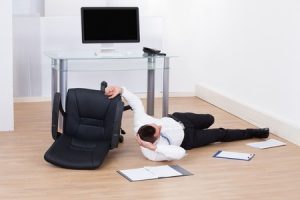
You could make an office accident compensation claim if you were injured in an office because an employer, occupier, building manager, contractor or another responsible party failed to take reasonable care. Office accident claims can involve slips, trips, falls, unsafe stairs, loose cables, defective furniture, poor workstation setup, manual handling injuries, falling objects, electric shocks, office kitchen accidents or car park accidents. Legal Expert’s personal injury solicitors can assess your claim for free and may be able to help you claim on a No Win No Fee basis.
An office accident can feel unexpected. Offices are not usually seen as dangerous workplaces, but injuries can still happen when walkways are cluttered, equipment is defective, workstations are poorly set up or routine safety checks are missed. Even a seemingly simple fall, chair collapse or lifting injury can affect your ability to work, travel, sleep and manage everyday tasks.
The impact is not always physical either. You may be worried about taking time off work, reporting the accident to your employer, paying bills while you recover or dealing with symptoms that make office work harder than it used to be. Back pain, neck pain, wrist injuries, headaches, anxiety and reduced mobility can all disrupt your normal routine.
At Legal Expert, our personal injury solicitors can explain whether you may have an office accident claim and what evidence could help prove it. We can look at who may be responsible, whether health and safety failings played a part and what compensation could include.
We offer a free consultation where you can discuss what happened, understand your rights and explore your legal options without obligation. To get started, just tap below.
4.8 (466 reviews)
We're No Win No Fee Solicitors Trusted by thousands to win compensation.
To learn more about office accident compensation claims and when compensation may be possible, please keep scrolling.
Can I Make An Office Accident Compensation Claim?
An office accident claim may be possible where your injury was caused by negligence. In practical terms, this means someone who owed you a duty of care failed to take reasonable steps to keep you safe, and that failure caused your injury.
Most office accident compensation claims involve employees injured at work. However, claims can also involve visitors, contractors, cleaners, delivery drivers, agency workers, clients attending meetings or people using shared office spaces.
You will usually need to show that:
You were owed a duty of care by an employer, occupier, building manager, landlord, contractor or another responsible party
That person or organisation failed to take reasonable safety steps
The failure caused an accident or harmful working conditions
You suffered an injury as a result
Your claim is still within the relevant time limit
Office accident injury claims may involve:
Tripping over loose cables, boxes, bags or cluttered walkways
Slipping on a wet floor near toilets, kitchens, entrances or reception areas
Falling on unsafe stairs or poorly maintained flooring
An office chair collapsing or defective furniture causing injury
Back, neck, shoulder or wrist problems linked to poor workstation setup
Injuries from lifting files, archive boxes, water bottles, office equipment or deliveries
Electric shocks caused by faulty plugs, cables or office equipment
Injuries caused by falling objects from shelves, cabinets or storage areas
Accidents in office car parks, loading bays or shared building entrances
In our experience, the strongest office accident claims are usually supported by clear evidence. This may include accident book records, photographs, CCTV, witness details, medical evidence, emails reporting hazards, workstation assessments or maintenance records.
Office buildings often involve more than one responsible party. Your employer may control your work tasks and equipment, but a building manager may control stairwells, lifts and communal areas. A landlord may be responsible for structural repairs, while cleaners or maintenance contractors may be responsible for specific hazards.
The key question is control. Our solicitors will look at who controlled the area, equipment, process or hazard that caused your injury and determine who may be at fault. Let’s look at some of those potential parties in more detail.
Employers
Under the Health and Safety at Work etc. Act 1974, employers owe their employees a duty of care. This means they must take reasonable steps to protect employee health, safety and welfare at work.
In an office, those reasonable steps may include:
Carrying out risk assessments to identify workplace hazards
Keeping walkways, stairs and exits safe
Providing staff training where needed
Maintaining desks, chairs, filing cabinets and electrical equipment
Completing display screen equipment and workstation assessments where required
Having a written health and safety policy where required
If your employer failed to take reasonable precautions and you were injured as a result, you may be able to bring an accident at work claim.
Office Occupiers And Building Managers
Some office accidents happen in areas that are not controlled by the employer alone. For example, a shared reception, lift lobby, stairwell, corridor, communal toilet, kitchen or car park may be managed by a building owner, serviced office provider or facilities company.
An office occupier or building manager may be responsible for hazards such as:
Broken stair nosings or loose floor coverings
Poor lighting in corridors or stairwells
Faulty lift doors or unsafe communal areas
Wet floors in shared entrances, kitchens or toilets
Damaged handrails, doors or glass panels
Unrepaired defects that had already been reported
If you were injured in a shared or serviced office, Legal Expert can help assess who had control of the relevant area and whether a claim may be possible.
Contractors, Cleaners And Maintenance Companies
Office safety can also depend on third-party contractors. Cleaners, electricians, builders, IT technicians, facilities teams and maintenance companies may create risks if work is not carried out safely.
Examples may include:
A cleaner mopping a floor and leaving it wet without proper warning signs
A maintenance contractor leaving tools, cables or materials in a walkway
An electrician failing to repair faulty wiring or defective sockets properly
A contractor carrying out works without barriers or clear signs
A facilities company failing to repair reported hazards within a reasonable time
Where a contractor caused or failed to fix the hazard, they may be wholly or partly responsible for the accident.
Landlords And Shared Office Providers
Modern offices are often leased, serviced or shared. This can make liability less straightforward. A landlord, co-working provider or building management company may be responsible for some parts of the building, while the employer remains responsible for work activities, staff training and workstation safety.
Legal Expert’s solicitors can review the available evidence and help identify which party may be legally responsible.
Common Types Of Office Accident Claims
Office injuries often begin with ordinary hazards that were not dealt with properly. A trailing cable, unstable chair or wet kitchen floor may seem minor until someone falls, suffers a back injury or cannot return to work.
Common office accident claims include:
Slips, trips and falls caused by wet floors, loose cables, damaged carpets or cluttered walkways
Falling objects from shelves, cupboards, filing cabinets or storage areas
Cuts and lacerations caused by broken glass, defective equipment, sharp furniture or unsafe fixtures
Manual handling injuries from lifting boxes, files, office supplies, equipment or deliveries
Electrical burns or electric shocks caused by faulty wiring, plugs, extension leads or office equipment
Defective chair, desk or filing cabinet injuries
Workstation injuries involving poor desk, chair, screen or keyboard setup
Burns and scalds in office kitchens
Falls on stairs, ramps, steps or in communal areas
Accidents in office car parks or loading areas
There are many ways someone can be injured in an office. The important point is not the type of accident alone, but whether reasonable precautions should have prevented it.
Slip, Trip And Fall Claims In Offices
Slips and trips remain a common office risk because office spaces are busy, shared and often full of everyday obstructions. A claim may arise where the hazard should have been noticed, removed, repaired or clearly signposted.
Office slip and trip claims may involve:
Loose cables across walkways
Boxes, bags, files or deliveries left in corridors
Wet floors near kitchens, toilets or entrances
Rainwater brought into reception areas
Recently cleaned floors without suitable controls
Damaged carpets, broken tiles or uneven flooring
Poorly lit stairwells or corridors
Unstable mats near doors or lift areas
Cluttered desks, meeting rooms or storage spaces
Evidence can be especially important in these claims because hazards may be moved, dried, cleaned or repaired quickly after an accident. Photographs and witness details can help show what the area looked like at the time.
Office Workstation And Display Screen Equipment Injury Claims
Not all office injuries happen in a sudden fall. Some develop because a workstation is unsuitable or because concerns are ignored over time. Display screen equipment, often called DSE, includes devices such as computers, laptops, tablets and smartphones used for work.
Workstation issues may contribute to:
Back pain
Neck pain
Shoulder pain
Wrist and hand symptoms
Repetitive strain injuries
Eye strain and headaches
Symptoms made worse by poor posture or unsupported working positions
A claim involving DSE or workstation setup will usually need evidence that the employer failed to take reasonable steps. This may include not carrying out a workstation assessment, ignoring requests for equipment, failing to address a known risk or providing unsuitable furniture.
This does not mean every ache or discomfort at a desk will lead to compensation. A solicitor will look at the work setup, what was reported, what action was taken, medical evidence and whether negligence caused or worsened your injury.
Manual Handling And Lifting Injury Claims In Offices
Office workers may not think of their job as physical, but lifting tasks still happen. Moving archive boxes, files, printers, water bottles, office furniture, event equipment or deliveries can cause injury if the task is not planned safely.
No trolley, lifting aid or assistance for heavy items
Being asked to lift items that were too heavy or awkward
Poor storage layouts that forced unsafe bending or twisting
Repeated lifting of files, boxes or deliveries
Insufficient staffing for moving furniture or office equipment
Failure to consider a worker’s known health condition or limitations
Back injuries are common in manual handling claims, but shoulder, neck, wrist, knee and soft tissue injuries can also occur.
Defective Office Equipment And Furniture Claims
Office furniture is used every day, so faults may become dangerous if inspections and repairs are not carried out. A broken chair, unstable filing cabinet or damaged desk can cause serious injury.
Examples of defective office equipment claims include:
An office chair collapsing because of a known defect
A filing cabinet tipping because it was unstable or overloaded
Broken shelves causing items to fall
Defective ladders or step stools used to access storage
Damaged desks, doors or glass partitions causing cuts
Faulty plugs, sockets, chargers, extension leads or office machinery causing electric shock
Equipment continuing to be used despite previous complaints
Maintenance records, inspection logs, photographs and emails reporting the defect can be useful evidence in these claims.
Office Kitchen, Stair And Communal Area Accident Claims
Some of the most overlooked office hazards are found away from the desk. Kitchens, toilets, stairwells, lift lobbies, receptions, meeting rooms and corridors can all create risks if they are not properly managed.
Claims may involve:
Scalds from kettles, boiling water or hot drinks
Burns caused by microwaves, hot surfaces or faulty appliances
Slips caused by leaking fridges, dishwashers or water coolers
Falls on stairs due to poor lighting, damaged steps or missing handrails
Trips in corridors caused by poor housekeeping
Accidents in reception areas caused by wet floors or loose mats
Lift lobby accidents caused by damaged flooring or inadequate lighting
Where several businesses share the same building, liability may depend on who was responsible for maintaining that part of the premises.
Office Car Park Accident Claims
An office accident claim may also involve a staff or visitor car park. These claims can overlap with workplace, occupiers’ liability and road traffic accident principles.
Trips caused by potholes, broken tarmac or uneven surfaces
Slips caused by ice, snow, oil, poor drainage or wet surfaces
Falls caused by poor lighting or damaged pedestrian routes
Being hit by a reversing vehicle
Accidents involving delivery vehicles or loading bays
Injuries caused by defective barriers, gates or security equipment
Evidence may include CCTV, dashcam footage, photographs, witness details, vehicle details, insurance information, maintenance records and accident reports.
Can I Claim For An Accident While Working From Home?
Home and hybrid working can make office accident claims more complex. Not every accident at home will be work-related, even if it happens during working hours. However, an employer may still need to manage certain work-related risks for remote workers.
A home working claim may need to consider whether:
The injury was caused by work equipment supplied by your employer
A DSE or workstation risk was ignored
You raised concerns about your setup and no reasonable action was taken
You were required to carry out unsafe lifting or equipment tasks at home
Your working arrangements created a foreseeable risk that should have been addressed
These cases can be evidence-sensitive. Emails, workstation assessments, equipment requests, photographs of the setup and medical records may all be relevant.
Common Injuries Caused By Office Accidents
Office accident injuries vary widely. Some people recover quickly, while others experience long-term pain, reduced mobility, work restrictions or psychological effects.
Eye strain and headaches linked to workstation issues
Psychological harm after a serious office accident
Medical evidence is usually needed to value an office injury compensation claim. It can show what injury you suffered, what treatment was needed, how long recovery may take and whether symptoms could affect your future work or daily life.
What Evidence Could Help An Office Accident Claim?
Evidence is often what separates a strong office accident claim from an uncertain one. It can show what happened, who knew about the risk, what action was taken and how the injury affected you.
Useful evidence may include:
An accident book entry
A workplace incident report
Photographs of the hazard, such as loose cables, wet floors, broken chairs or damaged stairs
Medical records from a GP, hospital, walk-in centre or physiotherapist
Emails or messages reporting the hazard before the accident
Risk assessments
DSE or workstation assessments
Training records
Maintenance records
Cleaning logs
Equipment inspection records
RIDDOR reports where applicable
Wage slips or proof of lost earnings
Receipts for treatment, travel, care costs or other expenses
Ask for evidence early where possible. CCTV, cleaning records and maintenance documents may not be kept indefinitely.
What Should I Do After An Office Accident?
Your first step should be to get medical help if you need it. Even if the injury seems manageable at first, a medical assessment can protect your health and create a record of your symptoms.
After an office accident, you should try to:
Report the accident to your manager, HR team, facilities team or building reception
Make sure the incident is recorded in the accident book or workplace reporting system
Take photographs of the hazard before it is repaired, cleaned or moved
Gather witness details
Keep emails or messages about the hazard
Ask whether CCTV is available
Keep copies of medical notes and appointment letters
Save receipts for treatment, prescriptions, travel or care
Record your symptoms and day-to-day difficulties in a diary
Speak to Legal Expert for free advice about your options
If you are unsure whether you need urgent medical care, you can read this NHS guide: Do I need to go to A&E?
How Much Office Accident Compensation Could I Claim?
There is no single average payout for office accident claims. The value depends on the injury, the recovery period, the medical evidence and the financial impact of the accident.
Compensation can be made up of two heads of loss:
General damages, which compensate you for physical pain, psychological suffering and loss of amenity
Special damages, which compensate you for financial losses caused by the injury
General damages may consider the severity of pain, the effect on your daily life, your recovery time and whether symptoms are ongoing. You may be asked to attend an independent medical assessment during the claims process.
Medical reports can then be considered alongside the Judicial College Guidelines. The JCG publishes guideline compensation figures for different types of injury.
Please remember that no specific amount of office accident compensation can be guaranteed because every claim is assessed on its own facts.
Free estimate tool
Personal Injury Compensation Calculator
Get a free and quick compensation calculation. Simply select an injury and find the estimated payout.
Figures are based on the 18th edition of the Judicial College Guidelines, published on 9 April 2026.
Compensation payouts could be higher as these figures only relate to physical injuries.
These estimates do not include financial losses like loss of earnings, care costs, travel expenses or medical treatment.
Can I Claim For Financial Losses After An Office Accident?
Special damages may allow you to claim back financial losses caused by your office injury. This part of the claim can be important if you needed time off work, paid for treatment or required help while recovering.
Financial losses may include:
Lost earnings
Future loss of earnings
Prescription costs
Private medical treatment
Physiotherapy
Counselling or psychological support
Travel expenses to hospital, GP or rehabilitation appointments
Care and support from relatives or paid carers
Ergonomic equipment where relevant and recoverable
Mobility aids
Home adaptations in serious injury cases
Evidence is essential. Payslips, invoices, receipts, bank statements, appointment letters and travel records can all help show what you lost financially.
How Long Do I Have To Start An Office Accident Claim?
The Limitation Act 1980 generally gives you three years to start a personal injury claim. This period usually begins on the date of the accident.
Some office injury claims are different because the injury may not be obvious straight away. For example, symptoms linked to a poor workstation, repetitive strain or gradual back pain may only be diagnosed later. The date you first knew, or could reasonably have known, that your injury was linked to negligence is known as the date of knowledge.
There are also exceptions for children and people who lack mental capacity. For children, the three-year period usually begins on their 18th birthday if no claim has already been started. Where someone lacks mental capacity, the time limit may be suspended unless capacity returns.
In these circumstances, a litigation friend may be able to act on behalf of the injured person. This could be a parent, guardian, family member, friend or another suitable adult who acts in the claimant’s best interests.
Because time limits can be strict and workplace evidence can be lost over time, it is sensible to seek advice as early as possible.
No Win No Fee Office Accident Claims
If you are concerned about the cost of claiming, Legal Expert’s solicitors may be able to handle your office accident claim under a No Win No Fee arrangement.
The type of contract commonly used is a Conditional Fee Agreement, often shortened to CFA. Under this type of agreement:
You do not pay upfront solicitor fees to start the claim
You do not pay solicitor fees while the claim is ongoing
You do not pay your solicitor for their work if the claim is unsuccessful
A success fee is only deducted if your claim succeeds
How Legal Expert Can Help With Office Accident Compensation Claims
At Legal Expert, our personal injury solicitors can assess your office accident claim for free and explain whether you may have grounds to seek compensation. We will listen to what happened, identify the key legal issues and give practical advice on the next steps.
Our solicitors can help by:
Assessing whether your claim has reasonable prospects of success
Identifying who may be liable for your office injury
Explaining the claims process in plain English
Helping you gather evidence
Reviewing accident reports, emails, CCTV, risk assessments and medical records
Arranging an independent medical assessment where needed
Calculating general damages and special damages
Corresponding with insurers, employers or other third parties
Negotiating the best and fairest settlement possible
Assisting with interim payment applications where appropriate
Finding legal representation if the claim proceeds to court
In our experience, office accident claims often benefit from early advice because emails, CCTV, maintenance records and workstation assessments can be easier to secure before too much time passes.
We offer a free consultation where you can discuss what happened, understand your rights and explore your legal options without obligation. To get started, just tap below.
Fill in our claim online form and an advisor from our team will call you back
Below, you can find answers to some common questions on office accident compensation claims.
Can I make an office accident claim?
You can make an office accident claim if you were injured because an employer, occupier, building manager, contractor or another responsible party failed to take reasonable care. You will need evidence showing that negligence caused your injury.
What are common office accident claims?
Common office accident claims include slips, trips, falls, defective chair injuries, falling object injuries, manual handling injuries, electric shocks, cuts, burns, workstation injuries and accidents in office kitchens, stairwells or car parks.
Can I claim for a slip or trip in an office?
You may be able to claim if the slip or trip was caused by negligence. Examples include loose cables, wet floors, poor lighting, damaged carpets, cluttered walkways or hazards that had been reported but not fixed.
Can I claim for an office chair injury?
You may be able to claim if a defective office chair collapsed or caused injury because it was not maintained, inspected or replaced when it should have been. Photographs, witness details and maintenance records may help support this type of claim.
Can I claim for a workstation or DSE injury?
A claim may be possible if a poor workstation setup, lack of assessment or ignored equipment request caused or worsened an injury. These claims often rely on medical evidence, DSE assessments, emails and details of the working setup.
Can I claim if I was injured while working from home?
Possibly. Not every home accident is a workplace claim, but compensation may be possible if the injury was caused by work equipment, unsafe work requirements or a failure to manage known work-related risks.
What evidence do I need for an office accident claim?
Useful evidence may include accident book records, CCTV footage, photographs, witness details, medical records, emails reporting hazards, risk assessments, DSE assessments, training records, maintenance records and proof of financial losses.
How much office injury compensation could I receive?
The amount depends on the severity of your injury, your recovery period, the impact on your life and your financial losses. Medical evidence is usually needed before a claim can be valued accurately.
How long do I have to start an office accident claim?
In many personal injury claims, the general time limit is three years from the accident date or date of knowledge. Exceptions may apply for children and people who lack mental capacity.
Can I make a No Win No Fee office accident claim?
If your claim has reasonable prospects of success, Legal Expert’s solicitors may be able to handle it under a No Win No Fee agreement. This means you do not pay upfront solicitor fees to begin your claim.
 Skip to content