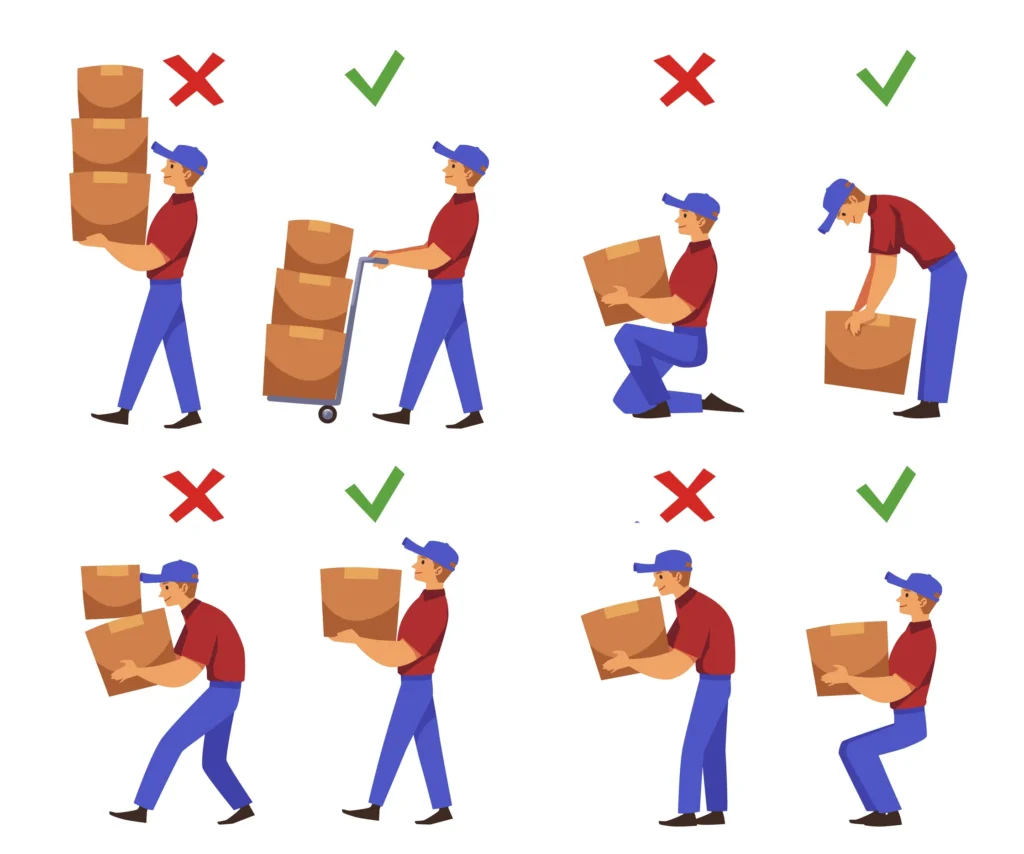
You may be entitled to make a manual handling claim if you were injured at work because your employer failed to reduce the risks linked to lifting, carrying, pushing, pulling, or moving loads. Manual handling injury claims can involve back injuries, shoulder injuries, slipped discs, hernias, soft tissue damage, musculoskeletal disorders, and long-term pain. Compensation may help cover pain and suffering, lost earnings, treatment costs, rehabilitation, care needs, and other financial losses caused by the injury.
Manual handling injuries can be extremely disruptive. A painful back, shoulder, neck, or wrist injury can make it difficult to work, drive, sleep, lift objects, care for family, or manage ordinary daily tasks.
These injuries are often underestimated because they may begin as stiffness, discomfort, or a strain that gets worse over time. For some workers, the impact can be serious, especially where their job depends on lifting, carrying, loading, pushing, pulling, or repetitive physical movement.
Employers should take reasonable steps to reduce avoidable manual handling risks. This can include proper training, suitable lifting aids, safe systems of work, realistic workloads, and proper risk assessments.
At Legal Expert, we understand how stressful it can be when a workplace injury affects your health, income, and confidence. Our experienced solicitors understand how manual handling injury claims work and can help support you through the process with clear, compassionate advice tailored to your circumstances.
To speak with us today and get free advice, please reach out to us by tapping below.
4.8 (466 reviews)
We're No Win No Fee Solicitors Trusted by thousands to win compensation.
To learn more about manual handling claims and when compensation may be possible, please keep scrolling.
What Are Manual Handling Claims?
Manual handling claims are compensation claims made after someone is injured because of unsafe manual handling tasks at work. These claims usually arise where an employer failed to take reasonable steps to protect a worker from avoidable harm.
Manual handling can include:
Lifting boxes, stock, tools, equipment, or materials
Carrying heavy or awkward loads
Pushing roll cages, trolleys, beds, wheelchairs, or machinery
Pulling loads or equipment
Loading or unloading deliveries
Moving people, animals, or patients as part of work
Repeating the same physical task over long periods
Manual handling injuries may happen suddenly, such as when a worker lifts a heavy object and feels immediate back pain. They can also develop gradually through repeated strain, poor technique, heavy workloads, or lack of suitable equipment.
If you were injured during a manual handling task, this may form part of an accident at work claim.
Can I Make A Manual Handling Injury Claim?
You may be able to make a manual handling injury claim if you can show that your employer’s negligence caused or contributed to your injury.
To claim compensation, it will usually need to be shown that:
Your employer owed you a duty of care
Your employer breached that duty
The breach caused or contributed to your manual handling injury
Employers owe workers a duty of care under the Health and Safety at Work etc. Act 1974. This means they must take reasonable steps to protect employees from avoidable injury.
The Manual Handling Operations Regulations 1992 also set out specific duties relating to manual handling tasks. Employers should avoid hazardous manual handling where reasonably possible, assess unavoidable manual handling risks, and reduce those risks as far as reasonably practicable.
Examples of employer negligence may include:
Failing to provide manual handling training
Expecting workers to lift loads that are too heavy
Failing to provide lifting aids or suitable equipment
Not carrying out risk assessments
Understaffing tasks that require two or more people
Ignoring previous complaints about unsafe lifting
Failing to allow suitable rest breaks during repetitive handling work
For example, you may be able to claim if having no training caused a lifting accident, or if you suffered an unloading injury because safe working procedures were not followed.
If you are unsure whether your employer may be responsible, Legal Expert can provide a free consultation where you can explain what happened and receive clear advice on your options.
Manual handling means transporting or supporting a load by hand or bodily force. This can include lifting, putting down, pushing, pulling, carrying, or moving a load.
A load can include:
Boxes or stock
Tools or machinery
Building materials
Furniture
Care home residents or hospital patients
Animals
Delivery items
The risk of injury can increase where loads are heavy, awkward, unstable, difficult to grip, carried over distance, or lifted in cramped spaces. Risks can also increase where workers repeat the same manual handling task many times during a shift.
Lifting
Lifting injuries can happen when workers are required to lift heavy, awkward, or unstable loads without proper support. These injuries commonly affect the back, shoulders, neck, arms, and wrists.
Carrying
Carrying loads over distance can create strain, especially where the load blocks visibility, affects balance, or has to be carried up stairs, through narrow routes, or across uneven surfaces.
Pushing And Pulling
Manual handling is not limited to lifting. Pushing or pulling roll cages, trolleys, pallet trucks, hospital beds, bins, or other equipment can cause injury if the load is too heavy, equipment is defective, or flooring is unsuitable.
Repetitive Manual Tasks
Some manual handling injuries develop over time. Repeated lifting, twisting, bending, reaching, or carrying can lead to musculoskeletal disorders, tendon injuries, shoulder problems, chronic back pain, or other long-term conditions.
How Common Are Manual Handling Injuries In The Workplace?
Manual handling is a major cause of workplace injury in Great Britain. The Health and Safety Executive is Britain’s regulator for workplace health and safety. According to HSE workplace injury statistics, handling, lifting, or carrying accounted for 17% of workplace accidents in 2023/24.
HSE statistics for that period also show that manual handling accidents were reported across sectors including:
Human health and social work
Manufacturing
Transportation and storage
Wholesale and retail
Construction
These figures show why proper training, risk assessments, supervision, and safe systems of work are so important.
Common Causes Of Manual Handling Injuries
Manual handling injuries can happen in many different ways. Some involve a single accident, while others develop because workers are exposed to repeated unsafe handling tasks. Let’s take a look at some of the most common ones we see in our experience.
Lifting Heavy Objects Without Assistance
Workers should not be expected to lift loads that are too heavy or awkward without help. If a task reasonably requires two people, lifting equipment, or a different system of work, an employer should take this into account.
For example, if you were told to carry a load by yourself that should have required two people, and you dropped it on your foot or injured your back, this may support a manual handling injury claim.
Poor Manual Handling Training
Manual handling training helps workers understand how to lift, carry, push, and pull safely. A lack of training can increase the risk of back injuries, shoulder injuries, muscle strains, and other harm.
Training should be relevant to the tasks workers are actually expected to perform. Generic training may not be enough where the job involves specialist equipment, unusual loads, or high-risk environments.
Repetitive Lifting And Strain Injuries
Some workers suffer injury because they repeat the same lifting or carrying task for long periods. This may happen in warehouses, factories, shops, hospitals, care settings, delivery jobs, and construction sites.
Repeated manual handling can contribute to soft tissue injuries, chronic pain, tendon problems, and musculoskeletal disorders.
Unsafe Workplace Systems
Unsafe systems of work may include poor shift planning, unrealistic workloads, lack of rest breaks, insufficient staffing, or requiring workers to carry loads through unsuitable routes.
For example, a worker may suffer a soft tissue injury after carrying loads for hours without appropriate rest or task rotation.
Lack Of Proper Equipment
Employers should consider whether manual handling aids are needed. These may include trolleys, lifting straps, pallet trucks, hoists, wheeled cages, powered trucks, or other equipment.
If suitable equipment was not provided, or if equipment was defective, this may support a manual handling injury compensation claim.
Pressure To Lift Beyond Safe Limits
Some workers feel pressured to lift loads they know are unsafe because of staffing shortages, time pressure, or workplace culture. In our experience, many injured workers worry about complaining or asking for help because they do not want to be seen as difficult.
However, employers should not rely on workers “just getting on with it” where manual handling risks are foreseeable and preventable.
Common Manual Handling Injuries
Manual handling accidents can cause a wide range of injuries. Some may heal with rest and treatment, while others can cause long-term pain, reduced mobility, and difficulty working.
Back Injuries
A back injury is one of the most common consequences of unsafe manual handling. These injuries may involve muscle strain, ligament damage, nerve irritation, or damage to the spine.
Slipped Discs
A slipped disc can occur where pressure damages one of the discs between the bones of the spine. This can cause pain, numbness, weakness, and symptoms that travel into the legs or arms.
Shoulder Injuries
Lifting overhead, carrying awkward loads, or repetitive handling can cause shoulder injuries. These may include tendon damage, dislocations, strains, and rotator cuff injuries.
Neck Injuries
Neck injuries may happen where workers lift awkward loads, twist while carrying items, or are forced into poor posture during manual handling tasks.
Hernias
Heavy lifting may contribute to a hernia, particularly where the worker is required to lift without assistance or suitable equipment.
Muscle And Soft Tissue Injuries
Manual handling accidents commonly cause sprains, strains, torn muscles, ligament damage, and soft tissue injuries. These injuries may still cause significant pain and time away from work.
Repetitive Strain Injuries
Repeated manual handling tasks can contribute to repetitive strain injuries affecting the wrists, elbows, shoulders, neck, or back.
Long-Term Chronic Pain
Some manual handling injuries leave workers with chronic pain. This can affect sleep, mental wellbeing, work capacity, family life, and overall quality of life.
Which Jobs Commonly Lead To Manual Handling Claims?
Manual handling injuries can happen in almost any workplace, but certain roles carry a higher risk because lifting, carrying, pushing, or pulling is part of the job.
The key issue is not simply whether your job involved manual handling. The question is whether your employer took reasonable steps to reduce the risk of injury.
Employer Responsibilities For Manual Handling Safety
Employers should usually consider whether they can:
Avoid hazardous manual handling tasks where reasonably possible
Assess manual handling tasks that cannot be avoided
Reduce the risk of injury as far as reasonably practicable
Make loads lighter, smaller, or easier to grasp
Break larger loads into smaller ones where possible
Provide suitable lifting aids or handling equipment
Ensure workers receive appropriate training
Provide enough staff for safe handling tasks
Review working practices if injuries or near misses occur
Risk assessments should be realistic and relevant to the work being done. They should consider the load, the task, the working environment, and the individual worker’s capabilities.
What Evidence Helps Support Manual Handling Injury Claims?
Manual handling injury claims need evidence showing how the injury happened, why the employer may be responsible, and how the injury has affected you.
Useful evidence may include:
Medical records
Accident book entries
Witness statements
Photographs of the load, workplace, or visible injuries
CCTV footage
Training records
Risk assessments
Manual handling policies
Occupational health reports
Emails or messages reporting unsafe tasks
Receipts, payslips, and bank statements showing financial losses
You can also use this government resource to learn how to request CCTV footage of yourself.
What To Do After Suffering A Manual Handling Injury
If you have suffered a manual handling injury at work, your first priority should be your health. You should seek medical attention as soon as possible, particularly if you have severe pain, numbness, weakness, swelling, or difficulty moving.
After the accident, it may help to:
Report the accident to your employer
Make sure the accident is recorded in the accident book
Ask for a copy of the accident report
Take photographs of the area, load, equipment, and injuries
Collect witness contact details
Keep medical records and appointment letters
Keep receipts and proof of financial losses
Write down how the injury affects your work and daily life
If you are worried that your employer may not have recorded the accident properly, or if you feel pressured not to claim, Legal Expert can provide confidential guidance on your rights.
How Much Manual Handling Compensation Could You Receive?
Manual handling compensation depends on the seriousness of your injury, your recovery, your long-term symptoms, and the financial losses caused by the accident.
Compensation may be made up of two parts:
General damages for pain, suffering, and loss of amenity
Special damages for financial losses caused by the injury
General damages reflect the physical and psychological impact of the injury. Whoever values your claim may refer to the Judicial College Guidelines, which set out guideline compensation brackets for different types of injury.
Our free calculator tool can help give you an idea of potential payouts for manual handling injuries:
Free estimate tool
Personal Injury Compensation Calculator
Get a free and quick compensation calculation. Simply select an injury and find the estimated payout.
Figures are based on the 18th edition of the Judicial College Guidelines, published on 9 April 2026.
Compensation payouts could be higher as these figures only relate to physical injuries.
These estimates do not include financial losses like loss of earnings, care costs, travel expenses or medical treatment.
Special damages may include:
Lost earnings
Future loss of earnings
Medical treatment costs
Physiotherapy or rehabilitation
Medication
Travel to medical appointments
Care and support costs
Home adaptations
Loss of workplace benefits or pension contributions
You must provide evidence of financial losses. This may include payslips, bank statements, receipts, invoices, and medical appointment letters.
This compensation information is provided as general guidance only. To understand what may be claimed in your specific circumstances, you can contact our team for a free consultation.
4.8 (466 reviews)
We're No Win No Fee Solicitors Trusted by thousands to win compensation.
Can Manual Handling Compensation Cover Lost Earnings?
Yes. If your manual handling injury caused you to lose income, this may form part of your compensation claim.
Lost earnings may include income lost because you needed time off work to recover. In more serious cases, compensation may also consider future lost earnings if the injury affects your ability to return to the same role or work the same hours.
You may also be able to claim for lost overtime, bonuses, pension contributions, or other workplace benefits where evidence supports those losses.
Can A Manual Handling Claim Cover Injuries That Develop Over Time?
Yes. Some manual handling injury claims involve conditions that develop gradually rather than from one single accident.
Examples can include tendonitis, chronic back pain, shoulder problems, repetitive strain injuries, and musculoskeletal disorders. These claims may rely on the date you first knew, or should reasonably have known, that your condition was linked to your work.
Gradual injury claims can be more complex because they may require evidence about your working conditions over time. Training records, risk assessments, shift patterns, job descriptions, occupational health records, and witness evidence may all be important.
Can I Claim If I Already Had A Back Problem?
You may still be able to claim if you already had a back problem, provided workplace manual handling negligence made your condition worse or accelerated symptoms.
For example, an employer may still be liable if unsafe lifting tasks aggravated a pre-existing injury. Medical evidence will be important in showing how much of your current condition was caused or worsened by the manual handling accident.
Can I Claim Against A Third Party For A Manual Handling Injury?
Yes, in some cases. Although many manual handling claims are made against employers, a third party may also be responsible.
Examples may include:
A defective lifting aid manufacturer
A contractor who supplied unsafe equipment
A maintenance provider who failed to repair equipment properly
A third-party supplier who created unsafe loading conditions
Legal Expert can assess whether a third-party claim may be viable in your circumstances.
If the injured person was under 18, the time limit is usually paused until their 18th birthday
If the injured person lacks the mental capacity to claim, the time limit may be suspended indefinitely
In either situation, a litigation friend may be able to claim on behalf of the injured person while the time limit is suspended.
If your injury developed gradually, the time limit may begin from the date you became aware that your condition was linked to work. Because time limits can vary depending on the facts, it is best to seek advice as soon as possible.
Can I Get Interim Payments While My Manual Handling Claim Is Ongoing?
In some cases, you may be able to request an interim payment before the claim fully settles.
An interim payment is an advance payment that may help with urgent costs such as lost income, treatment, rehabilitation, or care needs. It is usually only available where liability has been admitted or where there is strong evidence that the claim will succeed.
Any interim payment would be deducted from the final compensation award.
No Win No Fee Manual Handling Claims
If you are eligible to make a manual handling claim, you may be able to work with a solicitor on a No Win No Fee basis.
Under a Conditional Fee Agreement, you generally do not pay your solicitor upfront or while the claim is ongoing. You also do not usually pay your solicitor for their work if the claim is unsuccessful.
If your claim succeeds, your solicitor takes a success fee from your compensation. This fee is legally capped, which means you keep the majority of your compensation.
No Win No Fee agreements can make manual handling injury claims more accessible by reducing the financial risk of seeking legal help.
How Legal Expert Can Help
At Legal Expert, our solicitors can help with manual handling injury claims by providing clear, practical support throughout the process.
They may be able to help by:
Assessing whether you have a valid claim
Gathering evidence to support your case
Explaining legal terms in plain English
Communicating with the defendant on your behalf
Arranging expert medical evidence
Negotiating compensation
Helping you access rehabilitation support where appropriate
In our experience, many injured workers are unsure whether they can claim or worry about how making a claim might affect them. We can talk you through your rights and options in a free consultation, without obligation.
If you need to make a manual handling injury claim, our team could help you. Get in touch with our expert advisors today by tapping below.
Below, you can find answers to some common questions on manual handling claims.
Can I claim compensation for a manual handling injury?
Yes, you may be able to claim compensation for a manual handling injury if your employer failed to take reasonable steps to reduce the risk of injury and this caused you harm.
What is considered a manual handling injury?
A manual handling injury is an injury caused by lifting, carrying, pushing, pulling, or moving a load. Common examples include back injuries, shoulder injuries, hernias, soft tissue injuries, and musculoskeletal disorders.
Can I claim for a back injury caused by lifting at work?
Yes, you may be able to claim if you suffered a back injury because of unsafe lifting tasks, lack of training, excessive weight, inadequate equipment, or poor workplace systems.
What if I was not given manual handling training?
If you were not given suitable manual handling training and this contributed to your injury, it may support a manual handling injury claim.
Can repetitive lifting cause compensation claims?
Yes. Repetitive lifting can cause gradual injuries such as chronic back pain, tendon problems, soft tissue injuries, and musculoskeletal disorders. Claims may be possible where workplace risks were not properly managed.
How much manual handling compensation could I receive?
Manual handling compensation depends on injury severity, recovery time, financial losses, and long-term impact. Compensation may cover pain and suffering, lost earnings, treatment costs, rehabilitation, and care needs.
What evidence do I need for a manual handling injury claim?
Useful evidence may include medical records, accident reports, witness statements, photographs, training records, risk assessments, CCTV footage, and evidence of financial losses.
Can I claim if I already had a back problem?
Potentially, yes. You may still be able to claim if unsafe manual handling at work worsened a pre-existing back condition or accelerated your symptoms.
Can agency workers make manual handling claims?
Yes, agency workers may be able to claim if they were injured because the party responsible for their workplace safety failed to manage manual handling risks properly.
Can I claim against a third party for a manual handling injury?
Yes, in some cases. A defective equipment manufacturer, contractor, supplier, or maintenance provider may potentially be responsible if their negligence contributed to your manual handling injury.
Further Resources On Accident At Work Claims
Learn more about other accident at work claims we could help with:
Learn about claiming for a serious injury after an accident at work
 Skip to content